The world, the society, the economy, the country: all of them operate in a pyramid.
And at the top of the pyramid is the entity with the highest accumulation of resources.
Now, I will present the pyramid and how it works on every level and what is required to move from one level to the next.
This is applicable to free market capitalism and open democratic societies.
What makes me sad about the Indian society is that:
Good citizens who should be the ones to understand this theory and benefit from its acceptance -- are the ones who run away from it.
They don't accept the theory as a piece of fact.
They don't think of the government as a partner but as a enemy.
They think of the politician as a goon. A liability. A burden.
The stock market as a speculation device. As a betting race course.
Instead of thinking of how the system works together on a grand level, they think of each piece in a silo. Each above mentioned piece is useless in their own existence. But together, they are the resource allocation engines that drive every economic activity and the businesses within them.
This is what I call mistaking "structural ignorance" for "moral superiority".
The Theoretical Understanding of the Pyramid
The economy is not a flat marketplace of equal opportunity; it is a topological pyramid. As we go up the pyramid, the degree of competition decreases while the degree of leverage increases.
Most participants are taught that wealth is a function of Labor (Input). This theory posits that wealth is actually a function of Position (Topography). Where you sit in the flow of resources determines your margin more than how hard you work.
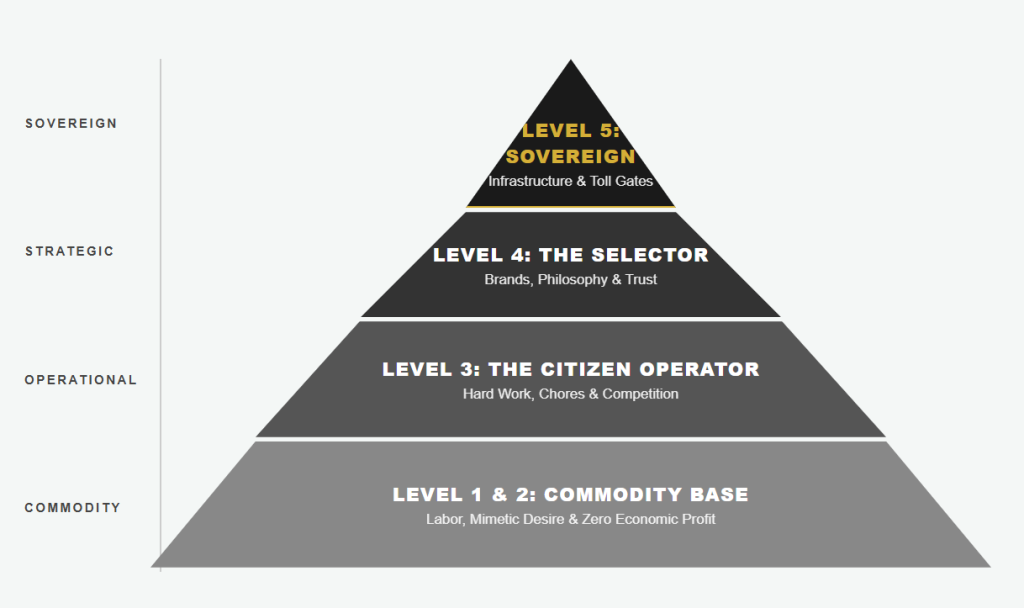
Level 1 & 2: The Laborers
- Definition: These levels are populated by individuals selling time and basic services.
- Mechanism: They are "Price Takers." Because their skills are common and their labor is replaceable, they compete in a "race to the bottom."
- The Trap: High Mimetic Competition. They look at their neighbors to see what to do, leading to an oversupply of the same services, which keeps margins at near-subsistence levels.
"Man is the creature who does not know what to desire, and he turns to others in order to make up his mind. We desire what others desire because we imitate their desires."
Things Hidden Since the Foundation of the World (1978) - Rene Girard (Peter Thiel's philosophical guru)
Level 3: The "Citizen" Operator (Small & Medium Business)
- Definition: This is the realm of the "Hard Worker." These are businesses that own assets (machinery, shops, inventory) but lack a "gate" or a "pipe."
- Mechanism: They provide genuine value and high-quality service, but they operate in Perfect Competition.
- The Symptom: The owner is the bottleneck. If the owner stops working, the business dies. They are effectively running a charity because they have no power to dictate prices to the market or the state.
You can keep running in a circle at Level 3 and hope that one day the cloud will burst open and reward you with tons of money or recognition for "hard work" or any other fantasies you may have, none of this is going to happen because of the design of the system and the incentives of the players within it.
Level 4: The Selector & The Brand (The Margin-Eaters)
- Definition: These entities own the Relationship and the Standard. They don't do the "hard work"; they curate it.
- Mechanism: Using Psychological Anchoring, they capture the customer's mind. Because the customer trusts the Brand, the Brand can "select" which Level 3 business wins.
Is this a good thing? One "brand" making all the money without doing any physical work of manufacturing the product itself?
It may not be a good thing, philosophically speaking.
But it is the market reality. That is how the market operates.
- The Symptom: They have high ROI and low CAPEX. They outsource the "messy" physical work to Level 3 while keeping the "clean" profit at the top.
Level 5: The Sovereign Infrastructure (The Toll-Booths)
- Definition: These are entities that own the Pipes of economy—physical, digital, or regulatory.
- Mechanism: They align with the State. They use subsidies, massive loans, and regulatory licenses to build infrastructure that the rest of the pyramid must use.
- The Symptom: They are "Too Big to Fail." They don't sell products; they collect "Taxes" (subscriptions, tolls, processing fees).
Level 6: The Politician
If we look at the politician through the lens of this theory, Politician is nothing but a toll booth business with a structural advantage. The advantage is that there are limited number of seats and they get to decide where all the public money is spent.
Level 7: The Political Party
The political party is a accumulation of politicians. So there is a compounding of the structural advantage.
Level 3: The "Hard Work" Trap
Small businesses at Level 3 are the backbone of society but the victims of the economy. Their primary characteristic is Fragility.
- The owner often works 14-hour days, effectively subsidizing the business with unpaid "sweat equity" just to stay competitive.
- The "Thief & Fool" Complex: Because Level 3 operators view business as a series of Chores rather than a System, they refuse to delegate. They believe "no one can do it as well as me," which prevents them from ever accessing Leverage (employees and loans).
If you think your customers are fools and the politicians are thieves, why are you running a business for fools and why are you accepting being regulated by thieves? - Price Taking: They are at the mercy of the "Selectors" (Level 4) and the "Toll-Booths" (Level 5). They take whatever price is offered because they have no structural reason for a customer to choose them over the 100 other identical business units.
Level 4/5: The Sovereign Price-Makers
Level 4 and 5 businesses have achieved Decoupled Returns. Their profit is no longer a remainder of their effort; it is a tax on the system’s friction.
- Institutional Memory: These businesses are Systems, not people. They survive the death or exit of the founder because the "Pipe" they own is a physical or legal reality.
- Regulatory Alignment: Unlike Level 3, which sees the government as an enemy or a tax-burden, Level 4/5 views the State as a Partner. They build assets that the state wants (employment, food security, infrastructure) in exchange for Structural Protection.
Structural Advantage: The Only Thing That Matters
Structural Advantage is the "Necessary and Sufficient" variable for printing money. It is the bridge that allows a business to move from the hyper-competitive Level 3 to the protected Level 5.
While Level 3 focuses on Product Quality (Internal), Structural Advantage focuses on Market Topology (External). It is the act of placing yourself at a "bottleneck" where the flow of capital must pass through you.
How it Moves You from Level 3 to 5:
1. Shift from Chores to Systems
At Level 3, the business is an extension of your body. At Level 5, the business is a Legally Binding Machine. You don't manage people; you manage the Standard Operating Procedures (SOPs) that manage the people. If you are the smartest person in the room, you are at the wrong level.
2. Radical Leverage (Debt & Talent)
The "Good Citizen" fears debt and distrusts employees. The "Sovereign" knows that Loans are the fuel for asset accumulation and Talent is the engine. You don't "pay" for people; you invest in the capacity to detach your time from your income.
3. The Government as a Strategic Partner
Stop viewing the State as a predator. The government is a Co-Investor that provides the most affordable capital in the world via subsidies and grants. Your goal is to align your private profit with a "Sovereign Priority" (e.g., Food Security or Industrial Clusters) to unlock the Regulatory Shield.
4. Optimize for "Thinking Margin"
Hard work is a commodity; Structural Insight is a monopoly. You must brutally cut the "Hard Work" that offers zero leverage. Your 14-hour workday must shift from "Operating the Mill" to "Negotiating the Toll Gate." Silence and strategy are your highest-ROI activities.
5. High-Agency Networking
Arguing with laborers or truck drivers is a "Status Trap" that keeps you at the bottom. You must delegate conflict and spend your social capital on High-Value Nodes: Politicians, Bureaucrats, and Industry Leaders. You are no longer looking for "work"; you are looking for "Permissions" and "Alignments."
6. Sales as the Capture of Desire
Sales is not "selling a product"; it is the act of Defining the Standard. When you own the sales channel, you own the "Mimetic Mediator" role. You become the person who tells the market what to want, which allows you to dictate terms to the manufacturers (the Level 3s).
7. Banking as a Foundational Relationship
In the level 4 and 5 world, your Relationship Manager is more important than your plant manager. Access to credit is the ultimate "Oxygen." You must treat your bankers as partners who provide you with the liquidity.
Features and Symptoms of Structural Advantage
How do you know if a business has a structural advantage? It exhibits these symptoms:
1. Inelasticity (Price Dictation)
If you raise your prices and the customers cannot leave because the cost of switching (or the lack of alternatives) is too high, you have a structural advantage.
2. High Margin / Low Effort (IndiaMart)
If the tech is mediocre, the philosophy is simple, and the "hard work" is minimal—yet the business still prints money—it is sitting on a Network Effect or a Discovery Bottleneck.
3. Dependency Accumulation
The industry becomes dependent on you.
- The Customer is dependent on your Trust/Brand.
- The Competitor is dependent on your Infrastructure.
- The State is dependent on your Execution.
Understanding the Marwadi Structural Advantage:
- Own the Bank (Own the money) (Co-operative Banks to finance their own projects without the need for "approvals" by banks.)
- The Compliance Ecosystem (Own the Law) (A legal compliance system so strong that won't fail even when challenged in the Supreme Courts)
- The Political Funding (Own the License)
- Own the Trust (Temples and Schools in Society)
This is not a marwadi thing. It can be created by any group of humans coming together for economic prosperity. Just that it is a common practice among marwadis because they acknowledge the existence of this pyramid and come together to benefit from it.
Came across a tweet while writing this article that sums it up quite nicely.
Here is the text:
"Game theory explains why working harder inside a broken system is the worst response to that system. Because a system is never truly broken. It's just producing exactly the outcomes its own incentive structures were designed to produce, whether intentional or not. Working harder inside this system increases your output in the payoff matrix, but it simply won't change the actual structure of the system's matrix. Thus, the correct response is not more effort. Instead, you must aim to identify whose interests the current structure serves and position yourself in favor of those interests rather than against them. Change the game, or play the game that is actually being played. Either way, you must stop optimizing for the game you wish it to be and start acting realistically."