
There are three main engines:
Businesses for Wealth Creation.
Politicians for Tax Collection.
Monks for Allocation of Collected Taxes.
But the power dynamics are in reverse.
Monks sit on top of Politicians.
And Politicians sit on top of Businesses.
Each position has their own pros, cons and costs.
Let’s start analyzing them starting with Businesses:
The Businessman:
Pros: Wealth Accumulation, Luxury.
Cons: 24×7 tension, fear of the taxman and politician, fear of policy change, fear of competition.
Cost: To win in this segment is to maximize wealth accumulation. And for majority of cases, it means, disguise, manipulation, strategic tactics to corner customers and industries.
If you try to do business in India, you will have to deal with this. So doing business ethically without using technology and social media as leverage is going to trap you in a perpetual battle with the self.
The pre existing system works for a reason. The only way you can beat them is create leverage through the use of technology and social media such that, the old system is completely broken. Otherwise you cannot establish a new system. Then you will have to work with-in the pre-existing system. And that generally means disguise and manipulation.
The Politician:
Pros: Ultra Wealth Accumulation, Ultra Luxury
Cons: Totally hidden wealth, complete fear of public scrutiny of all dealings, political life risk. (Dealing with power means risking life)
Costs: Total disguise. Wealthy but hidden. Corruption. Scrutiny. Public Shaming and Risk of Life.
The Monk:
Pros: Total and Complete Public Support, Almost comparable to devotion. Total Power over Allocation of Public Resources (excess wealth generated by the businesses). No fear of damage or risk to family members.
Cons: Total and Complete Sacrifice of all material and societal pleasures.
Cost: Giving up family and material and societal pleasures as a proof of public accountability and non corruptibility.
The Mix-Up:
This is the most important part of my analysis:
Most successful participants have 2 layers working simultaneously for them to win:
Businessman with Monk Ethics (in Public Perception)
Tatas, etc.
Politician with Monk Ethics (in Public Perception)
Gandhi, Sharad Pawar, Yogi Adityanath and so on…
Public Perception is more Important than Real Personality.
If you are a very ethical person in reality but public perception does not fit within the monk-type cost structure framework (Cost of Monk: Perceived Sacrifice of Personal Luxuries and Pleasures) – then you are not considered a monk in the public perception – therefore you will never be accepted as an ethical person in the Indian society.
A very very recent example as on the date of writing this article:
The Chinese CEO of a Chinese Phone Manufacturing Company which sells “Made in India” (more like assembled in India phones) did this:
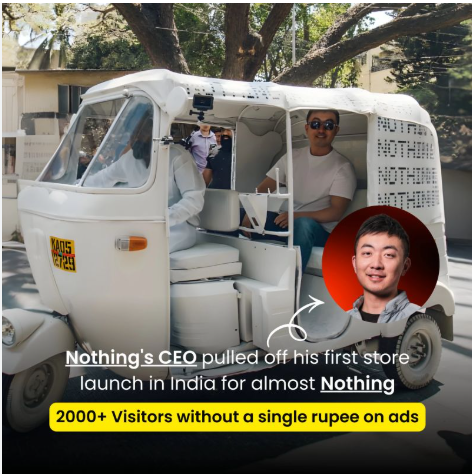
This is the concrete example of Pure Businessman trying to play the Monk to gain the trust of the people. And it works in India.
You might call it disguise, fake, manipulation, whatever.
Reality is that it works.
They have hired marketing agencies with millions of dollars of contracts to create a script for every public action. Because every public action drives public perception. And public perception drives business.
The cost of not understanding this or not doing this is that you keep doing something that does not work.
The baseline is Perception is more important than Reality. You have to win the perception game, whether or not you are personally ethical is a secondary question for a businessman.
If you want to make ethics the primary question, you have to become a monk. And then actually live your philosophy before you tell others what to do.
And for people to accept you as a real philosopher, you have to bear the cost of sacrifice of material and social pleasures.